|
|
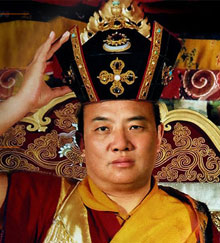
16th Karmapa — Rangjung Rigpe Dorje (1924-1981) was born into a noble family in Denkhok in Eastern Tibet, Kham, near the Dri Chu or Yangtze River. The previous Karmapa Khakhyab Dorje (1871-1922) left a letter setting forth the circumstances of his next incarnation. The Karmapa's attendant, Jampal Tsultrim, possessed the letter of prediction, which matched exactly with the proceeding the 11th Tai Situpa was already undertaking to find the 16th Karmapa.
It is said that while still in his mother’s womb, the baby could be heard reciting the mantra of Chenresig (Avalokiteshvara). When the child was born many rainbows appeared; he took seven steps, saying, “Mother, Mother! I am going away!” The Karmapa's identity as a child was kept secret, but nearby villagers noticed auspicious signs at his birth and came to him for blessings.
In 1931, at the age of seven, he performed his first Black Crown ceremony. He received his hair cutting ceremony at age thirteen from Thubten Gyatso, 13th Dalai Lama.
The 11th Tai Situpa, Pema Wangchok, gave him ordination at the age of seven, the Bodhisattva vows and many teachings. Beru Khyentse Lodro Miza Pampa'i Gocha taught him the tantras. Bo Kangkar Rinpoche taught him the sutras. Jamgon Palden Kyentse Oser taught him Mahamudra and the Six Yogas of Naropa. He regarded the 11th Tai Situpa, Pema Wangchok, and the 2nd Jamgön Kongtrül Khyentse Öser as his root gurus.
At Palpung monastery, where he took the empowerments and initiations of the Drubtab Kuntu collection, and studied the Vinaya Sutra, the Prajnaparamita, the Abhidharma Kosha, the Chakrasamvara Tantra, the Kalachakra Tantra, and other teachings, under the guidance of Situ Tulku and Khyentse Rinpoche. From Sechen Kongtrul Rinpoche, the 16th Karmapa received the initiation of “Longchen Dzod Dun”, the teachings of Longchenpa along with the full explanations. He received all these teachings in their complete form.
During his education he received all the Kagyu transmissions and was also taught by the Sakya Trizin (head of the Sakya school) for many years. In the beginning of 1940 he went into retreat, and in 1944, the 16th Karmapa made a pilgrimage to Trag and Samye monasteries and then visited the Drowolung monastery in south Tibet, the seat of Marpa the Translator, where he had marvellous visions of Marpa, Jetsun Milarepa and Je Gampopa.
In 1945, at age twenty-three, the 16th Karmapa received the detailed final ordination, together with the initiations and explanations of the higher Kagyu teachings from Situ Tulku.
In 1947 Karmapa visited Nepal, and started a pilgrimage to India, to holy places connected to the life of the Buddha. The 16th Karmapa travelled to India via Lumbini — the birth-place of the Buddha — and on to Sarnath and Bodh Gaya, continued to Ajanta, Ellora and finally to Kushinagara, the place of Lord Buddha’s final passing.
In 1948, Karmapa travelled to Rewalsar, in the north west of India, where he spent several days and performed a special rite of Guru Padmasambhava. Then, via Kunu and Purang, to the holy mountain of Kailash where he made three complete circumambulations of the mountain, taking three days for each one; and also went around the holy lake of Manasarovar.
In 1953, His Holiness the 16th Karmapa continued his education with the 10th Mindrolling Trichen of the Nyingma School, and journeyed to Lhasa, where he had an audience with His Holiness the 14th Dalai Lama, Tenzin Gyatso, and received the empowerment of Kalachakra initiation of the Gelugpa School. Rangjung had therefore received all the major teachings of all the major Tibetan Buddhist schools.
The 16th Karmapa continued his predecessor's activities, travelling and teaching throughout the East. His activity also included locating the rebirths of high reincarnate lamas spontaneously, without meditation.
Prior to the Chinese invasion of Tibet the Karmapa made a series of predictions indicating that the Tibetan people would need to be prepared to escape to India. In 1940, at age 16, Karmapa composed a poem that predicted the occupation of Tibet.
As political circumstances altered Tibet radically with the 1950 takeover by China. The Karmapa, along with the Dalai Lama, government officials, and other high lamas, attended talks in Beijing to negotiate a settlement. This succeeded for a while, but in 1959 the Chinese government insisted on land reform, which would undermine the system of independent monasteries in Tibetan Buddhism. Conflict with the lamas as spiritual leaders accelerated.
In February of 1959 Karmapa took 160 lamas, monks and laymen, from Tsurphu Monastery, the ancient seat of the Karmapas since the twelfth century, and escaped to Bhutan, taking the lineage's most sacred treasures, statues, ritual items, relics, icons, paintings, books with them. The hazardous and difficult journey, taking twenty-one days in all, passed through Lhodrag in southern Tibet, the birthplace of Marpa the Translator.
The party arrived safely in north Bhutan and were warmly welcomed by the government. At this time, discussions were started with the Government of India, considering future plans for the resettlement of the 16th Karmapa and his many followers. It was decided that all should transit through Bhutan and settle temporarily in Dharamsala, North Western India.
The King of Sikkim, offered the Karmapa the site where the 9th Karmapa had previously established one of the monasteries, which was then in ruins. It was here that the 16th Karmapa's seat-in-exile, Rumtek Monastery, was selected. This place possessed all the auspicious attributes needed for the site of a seat of the Karmapa: seven streams flowing towards it, seven hills facing it, a mountain behind, snow ranges in front, and a river below, spiralling downhill like the form of a conch shell.
Indian government provided all needed assistance in rebuilding the Rumtek. Rare treasured religious relics, icons and books that had been brought from Tibet were installed in the new monastery. On the first day of the first month of the fire horse year (1966), the 16th Karmapa ceremonially entered the new Center. It was a magnificent and highly auspicious occasion.
In the beginning of the 1970s the Karmapa made the prediction that Tibet would have a hard struggle gaining independence and even if it did, it would not allow the refugees to return. Rumtek would not be a good place either, and although Sikkim and Bhutan are still stable, they can deteriorate as well. However the Western world will embrace Buddhism, so he sent Lama Gendün to Europe.
In 1974, with the help of Freda Bedi, he embarked on his first world tour, and was welcomed in London among others by Hannah Nydahl and Lama Ole Nydahl. Karmapa traveled to Europe, Canada and the United States. For the first time, people in the West had the chance to see the Black Crown ceremony, which was performed on a number of occasions.
In 1974 the Karmapa visited the Hopi tribe in New Mexico; they had requested His Holiness to relieve their drought-stricken land. He conducted a ceremony, and a deluge of rain fell for the first time in seventy-five days. In the evening, Hopi and Navajo people were granted the empowerment of Red Chenrezig.
He established Dhagpo Kagyu Ling in France as the central seat of activity, gave several Black Crown ceremonies, and attended an audience granted by Pope Paul VI. In 1976-77 he began a more exhaustive tour, giving extensive teachings, visiting nearly every major city in Europe.
In November 1979, the 16th Karmapa laid the foundation stone for the Karmapa International Buddhist Institute (KIBI) in New Delhi, at a site that was originally given to him by Indira Gandhi for a center for advanced Buddhist studies. His vision was to foster wisdom and compassion through the study and translation of the great Buddhist treatises.
In May of 1980, Karmapa again visited the West, stopping for lectures and ceremonies in London, New York, San Francisco, and Boulder, Colorado. In 1980-81 the Karmapa began his last world tour, giving teachings, interviews and empowerments.
Rangjung Rigpe Dorjé died on November 5, 1981 in the United States.
The 16th Karmapa helped foster the transmission of Tibetan Buddhism to the West, established Dharma centers and monasteries in various places around the world in order to protect, preserve, and spread Buddha's teachings. As part of an initiative by the Tibetan government-in-exile to consolidate the organizations of Tibetan Buddhism, Rangjung Rigpe Dorje became the first formal head of the Kagyu School, although the earlier Karmapas had long been considered the most prestigious and authoritative lamas of that school.
The life of His Holiness the 16th Karmapa, Rangjung Rigpe Dorje, attested to the true meaning of “Karmapa”, which is “Activity of All Buddhas”.
Under his leadership, the Karma Kagyu lineage not only survived the escape from Tibet of most of the high Buddhist teachers — but thrived. The Karma Kagyu lineage spread all around the world. The Buddhist monasteries, institutes, and centers that the 16th Karmapa established grew and now offer Buddhist methods to people in India, Asia, and across the West.
The 16th Karmapa was a great master who demonstrated intuitive wisdom, joy, and loving kindness, his compassionate activity for others being beyond words or concepts. He was such a highly respected teacher across the Himalayas — including to the royal families of Sikkim and Bhutan — that masters of the other lineages would also call upon him for help and advice.
A major achievement of his was to resurrect the lineage of the Shamarpas. For political reasons, the reincarnations of the Shamarpas (which is the second-oldest reincarnate lineage in Tibetan Buddhism after the Karmapas), had been banned from formal acknowledgement by the Tibetan government. Throughout the 170-year ban, previous Karmapas had quietly recognised successive Shamarpas and trained them as spiritual lineage holders.
The 16th Karmapa informally recognised his nephew, Mipham Chokyi Lodro, when he was six years old. As he wished to formally enthrone him, the 16th Karmapa had appealed to the Tibetan Government. In 1957, while they were still in Tibet, His Holiness the 14th Dalai Lama dissolved the legal obstacles and approved the recognition. Shamar Rinpoche was officially enthroned in 1963 in Sikkim, and continued to stay with the 16th Karmapa until the latter’s death in 1981.
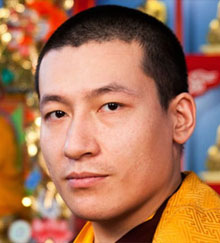
In March 1994, in accordance with tradition, the 14th Shamarpa, Mipham Chokyi Lodro, in turn recognised Thaye Dorje as the 17th Karmapa. Shamar Rinpoche passed away in June 2014.
The life and legacy of His Holiness the 16th Karmapa lives on through his reincarnation, Thaye Dorje, His Holiness the 17th Gyalwa Karmapa. |